You can top the Google Maps pack and still never get named by AI
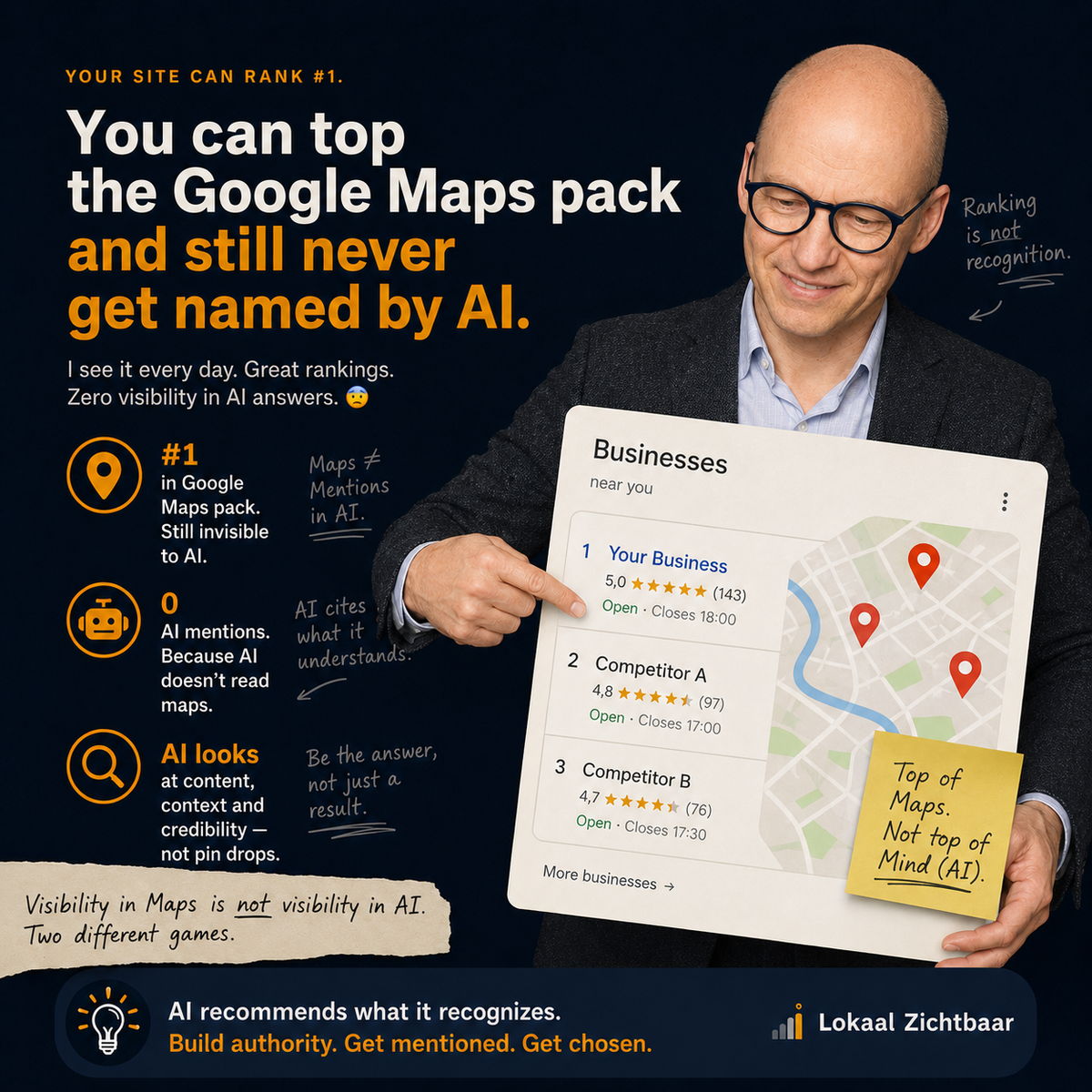
Ranking in the Google Maps top three does not, on its own, get you recommended by AI assistants. In a study of 72 AI answers about Dutch tradespeople in August 2026, only 24.3% of the recommendations — 55 out of 226 — were businesses that also appeared in the Maps top three for the same search. Three quarters sat outside the local pack entirely.
But the finding runs both ways, and the second half is the useful part: businesses inside the pack were named by all three assistants 18.2% of the time, against 7.0% for businesses outside it. Two and a half times the rate.
What we tested
We asked the question the way a customer asks it. Twenty-four queries: four Dutch cities — Amsterdam, Rotterdam, The Hague, Eindhoven — across three trades (plumber, electrician, heating engineer), in Dutch and in English. Each went to ChatGPT, Gemini and Claude in a fresh chat on a consumer account. The view a homeowner gets, not a business one.
That produced 72 answers naming 226 business-query combinations. We then pulled the Google Maps top three for each of the twelve Dutch search terms on 24 August 2026 and checked every recommendation against it.
One thing before the results. Not one of the 72 answers refused. Every assistant named businesses every single time, averaging 4.6 per answer. If you’ve heard that AI assistants won’t recommend local companies — across 72 answers, that never happened once.
Three quarters of AI recommendations sit outside the map pack
Of the 226 business-query combinations recommended across the 72 answers, 55 appeared in the Google Maps top three: 24.3%.
The gap between assistants is modest — Claude 31.9% (36 of 113), Gemini 30.0% (27 of 90), ChatGPT 26.4% (33 of 125). With one measurement per query we wouldn’t read much into the ordering, but the level is consistent across all three. None of them is copying the local pack wholesale.
So winning the map pack is not the same thing as being visible in AI. Related, yes. The same channel, no.
The map pack predicts whether the assistants agree
Split those 226 recommendations by how many of the three assistants named each business:
| Named by | Share that sat in the Maps top 3 |
|---|---|
| All three assistants | 45.5% (10 of 22) |
| Two of three | 36.2% (21 of 58) |
| Only one | 16.4% (24 of 146) |
Read the other way round — the direction that’s useful to you — a business in the Maps top three was named by all three assistants in 18.2% of cases (10 of 55), against 7.0% for businesses outside the pack (12 of 171).
The mirror image matters just as much. Outside the pack, 71.3% of businesses (122 of 171) were named by only one assistant. Inside it, 43.6% (24 of 55). A map-pack position doesn’t buy you broad visibility — nearly half of those businesses were still stuck with a single mention. It roughly halves the odds of that happening.
That’s the honest version. A strong Maps position is not an entry ticket and it isn’t a fix. It shifts the distribution. Which matters, because across the full study only 9.7% of the 226 recommendations reached all three assistants, and 64.6% came from just one. Being findable in ChatGPT tells a customer using Gemini almost nothing.
First place stands out; second and third don’t separate
Counting AI mentions per search term by Maps position, across twelve Dutch search terms:
| Maps position | AI mentions per search term |
|---|---|
| First | 3.3 |
| Second | 2.2 |
| Third | 2.7 |
First place does draw more mentions. But the ladder isn’t clean — third outperformed second, which with twelve search terms and one measurement each is roughly what noise looks like.
What we take from it: the gap between being in the pack and outside it is far larger and far clearer than any gap within it. If you’re already third, the case for spending heavily to reach first is weaker than the case for businesses outside the pack to get in at all.
What it looks like in practice
Two examples from the data, both anonymised.
In one city, the top result in the local pack for a trade search is a listing whose entire displayed business name is the name of that city. Nothing after it. The same profile also holds second place in the pack for a different trade in the same city. On the measure local SEO usually optimises for, it is doing extremely well. It picked up one AI mention out of six possible.
In another city, a business with 114 Google reviews was named in six out of six — every assistant, in both languages.
Opposite outcomes, and map-pack position alone explains neither.
What we’re not claiming
A snapshot, not a law. Four things to weigh before quoting any of it:
- One measurement per query, no repeat runs. Some variation between assistants is probably ordinary noise.
- Four cities, three trades, one country. Dutch trade services in August 2026.
- The Maps check used Dutch search terms only, and one of the twelve searches returned only two of the three positions.
- Claude is both one of the three assistants tested and the tool used to code the results. Claude scored highest on map-pack overlap. We don’t believe that’s connected — the coding is about which business names appear in a text, not a quality judgement — but you should know it and weigh the per-assistant ranking accordingly.
This is correlation, not mechanism. We can tell you which businesses each assistant named. Not why it picked them, and we haven’t guessed.
We also can’t promise you a position, and neither can anyone else. AI answers are non-deterministic: ask the same question twice and you can get two different lists. What you can do is measure where you appear today, fix what’s demonstrably broken, then watch the trend over months rather than days. That’s what how we measure AI visibility is built around.
How to check your own business in ten minutes
- Open ChatGPT, Gemini and Claude — three separate, fresh chats.
- Ask each one the question a customer would ask. Not “is [your business] good,” but “which plumber in [your city] would you recommend.”
- Write down every business named, in order, for each assistant.
- Repeat in English if you serve international customers. Expect a different list — that’s normal.
- Count how many of the three named you. That number, not your Maps rank, is your AI visibility today.
Appear in one but not the others, and you know exactly where the work is. If you run a trade services business, that gap is where most of the opportunity sits right now.
Or we’ll run it for you
We check where you appear across ChatGPT, Gemini and Claude — in Dutch and in English — and show you exactly which assistants name you and which don’t. No obligation.
Get your free visibility checkFrequently asked questions
Does ranking in the Google Maps top 3 get me recommended by AI?
Not on its own. In this study only 24.3% of AI recommendations (55 of 226) were businesses in the Maps top three. What a map-pack position did predict was consistency: those businesses were named by all three assistants 18.2% of the time, against 7.0% for businesses outside the pack.
What is the Google Maps top 3 (the “local pack”)?
The local pack is the block of three business listings Google shows above the regular results for a local search — name, star rating, review count and contact details, pulled from Google Business Profile. It’s what most local SEO work aims at.
Do AI assistants refuse to recommend local businesses?
No. Across 72 answers in this study there were zero refusals. Every assistant named businesses every time, averaging 4.6 per answer.
Do ChatGPT, Gemini and Claude recommend the same businesses?
Rarely. Only 9.7% of the 226 recommendations were named by all three assistants. 64.6% came from just one of the three.
Does it matter whether I’m first, second or third in the map pack?
First place drew more AI mentions per search term (3.3) than second (2.2) or third (2.7), but second and third didn’t separate — across twelve search terms that’s within noise. The difference between being in the pack and outside it was far larger than any difference inside it.
Method: 24 queries × 3 AI assistants = 72 answers. Four Dutch cities, three trades, Dutch and English. 226 business-query combinations; Google Maps top three checked 24 August 2026 for all twelve Dutch search terms (35 of 36 positions recorded). One measurement per query, no repeat runs. Exact query dates were not logged per row.
Background: you rank on Maps — so why doesn’t ChatGPT recommend you? →